Stadion Feijenoord (De Kuip) in Rotterdam
Stadion Feijenoord (De Kuip) in Rotterdam seats 51,117 in two free-hanging rings, opened in 1937 and reached by metro D or E from Centraal; guided tours take visitors into the tunnel and dressing rooms.
Photo credits
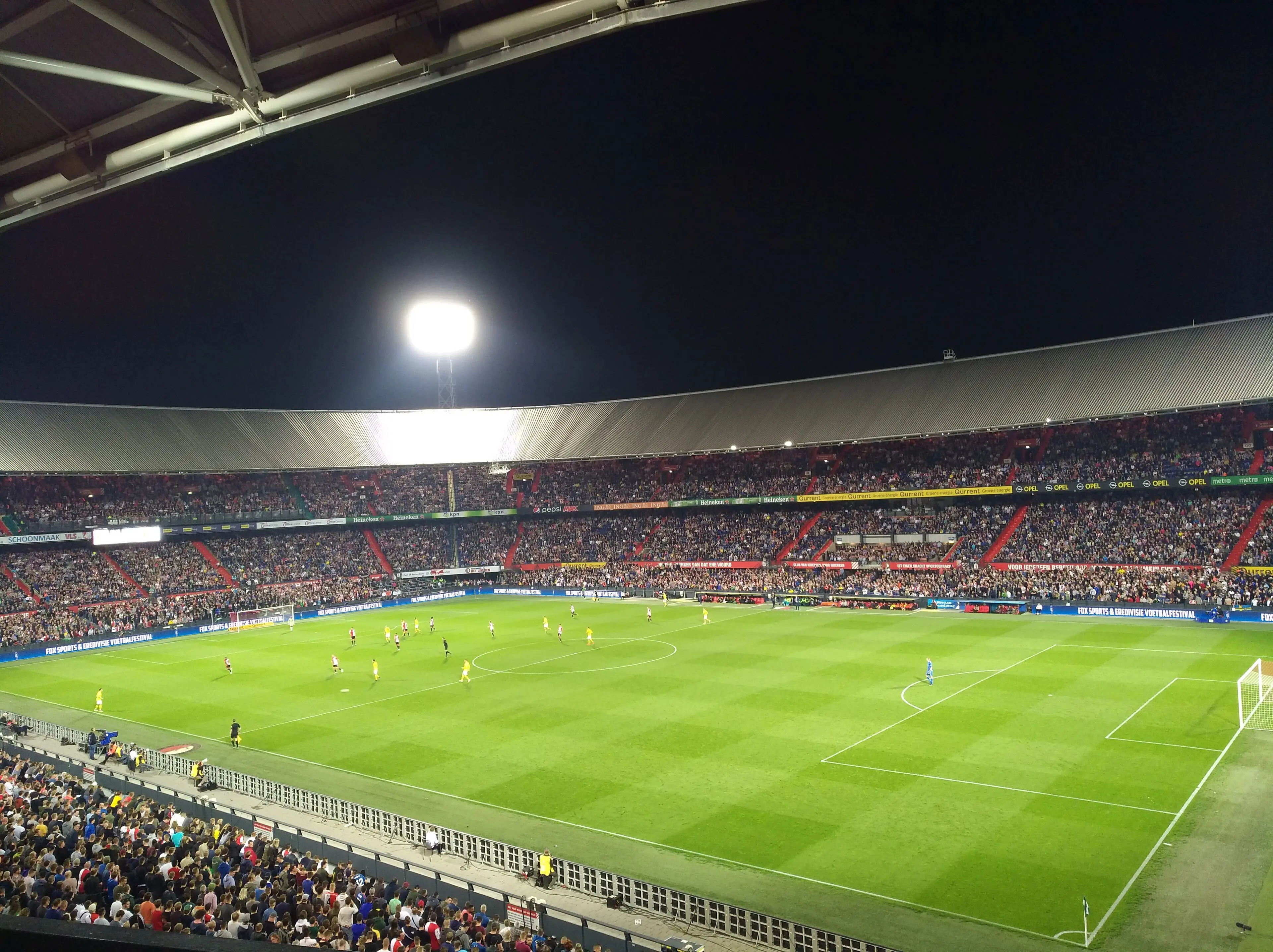
Feyenoord players on the pitch at De Kuip during an Eredivisie match against AZ, with the stands full behind them.: Sebleouf · CC BY-SA 4.0
Quick answers
- Capacity
- 51,117 seats
- Address
- Van Zandvlietplein 13077 AA Rotterdam
- Opened
- 1937; fully roofed in 1994
- Nearest metro
- Maashaven or Rijnhaven, lines D and E
- From Centraal
- Metro D or E to Maashaven
- Concerts
- No pop concerts since 2026
- Guided tour
- Tunnel, dressing rooms and pitch
- Address
- Van Zandvlietplein 1, Rotterdam
Stadion Feijenoord (De Kuip) agenda: upcoming events
Tonight, this week and the months ahead at this venue in Rotterdam.
Tonight
- Sat21Nov
November 2026
- Sun29Nov
December 2026
- Sun13Dec

- Sun20Dec
January 2027
- Sat2Jan
- Sun10Jan
- Sat23Jan
- Wed27Jan
May 2027
- Sun23May
Plan your visit to Stadion Feijenoord (De Kuip)
How many people fit in De Kuip?
- Official capacity
- 51,117 seats
- Capacity in 1937
- 65,000
- Record attendance
- 69,300 in 1949
Stadion Feijenoord holds 51,117 people, all seated. The figure dates from the 1994 renovation, when the standing areas were removed and the 65,000-capacity ground of 1937 became an all-seater stadium; the record crowd of 69,300 was set in 1949.
De Kuip is much larger than the other well-known venues in Rotterdam: Rotterdam Ahoy's arena holds about 15,000 and Stadion Woudestein about 3,531. Those are OpenStreetMap and Wikidata figures, while the stadium's own site gives the official 51,117.
| Venue | Type | Capacity | Source |
|---|---|---|---|
| Stadion Feijenoord (De Kuip) | Football stadium | 51,117 seats | Official venue site |
| Rotterdam Ahoy (arena) | Event arena | About 15,000 | Wikidata |
| Stadion Woudestein | Football stadium | 3,531 | Wikidata |
Seating plan: the two rings and which seats to choose
De Kuip has two continuous oval tiers of seats, all covered by the 1994 roof. The lower ring lies close to the pitch; the upper ring is completely free-hanging, with no columns blocking the view.
Lower ring
Close to the pitch, first tier
Upper ring
Free-hanging, unobstructed view
Roof
Full roof since 1994
The free-hanging second ring was a world first in 1937: the supports that carry the upper tier are hidden from spectators and players, so every seat looks straight at the pitch. The oval shape also avoids the empty corners of rectangular grounds, which is a large part of the famous Kuip atmosphere.
Tickets are sold by section and seat number. Lower-ring seats near the halfway line are closest to the action; the upper ring is higher and further back but gives a clear, uninterrupted overview. There are no standing terraces since the 1994 renovation.
- Lower ring near the halfway line: closest to the play.
- Upper ring: higher and further away, but no columns in the sightline.
- Every seat is numbered; there is no standing terrace since 1994.
- Home and away sections are separate, so check the block printed on your ticket.
How a guided tour of De Kuip works
A tour takes visitors behind the scenes of Feyenoord's home ground.
- Join a guided tour led by an experienced guide through the player tunnel and the dressing rooms.
- Sit on the manager's bench and see the pitch from several different viewpoints, including the stands.
- Hear stories about memorable matches and historic moments from the stadium's past.
- Finish with lunch or a drink at Brasserie de Cuyperij in the Maasgebouw.
- Tour times, prices and bookings are handled by the stadium's sales department, so check the official site before you go.
Food and drink at De Kuip
The stadium's own brasserie is the place to eat around a visit or a tour.
Brasserie de Cuyperij sits in the Maasgebouw and serves lunch in an authentic Feyenoord setting. The 1994 renovation also added business units to the ground, which are used on match days.
- Brasserie
- De Cuyperij, in the Maasgebouw
- Lunch
- Served after guided tours
Getting to De Kuip by metro, tram and from Centraal
Rotterdam Centraal is the main station. Take metro line D or E towards Slinge or De Akkers and get off at Maashaven or Rijnhaven; both stations are a short walk from the ground. Tram 2 also stops at Maashaven.
On match days thousands of supporters arrive at once. Allow time for the walk from the metro and check the last train or metro in the NS or RET planner afterwards, especially if you are travelling outside Rotterdam.
Parking at De Kuip: garages, addresses and cost
Parking in Rotterdam's city zones is paid; the municipality advises a P+R site at the edge of the city, where parking is often free, and continuing by public transport. For a match, Q-Park recommends its garages at Rijnhaven and on Kop van Zuid, followed by the metro to the stadium.
| Car park | Address | Walk to the ground | Rate |
|---|---|---|---|
| Q-Park Rijnhaven | Pudongstraat 4, Rotterdam | Metro D/E from Rijnhaven, about 12 min walk | Paid |
| Q-Park Boston & Seattle | Posthumalaan 35, Rotterdam | Metro to Maashaven, about 9 min walk | Paid |
| Q-Park de Rotterdam | Wilhelminakade 201, Rotterdam | Metro to Maashaven, about 9 min walk | Paid |
| P+R site (city edge) | Municipal P+R areas, Rotterdam | Metro D/E to Maashaven or Rijnhaven, then walk | Often free (municipality) |
- City parking
- Rotterdam has paid zones; P+R at the edge is often free
- Match-day advice
- Q-Park: park at Rijnhaven or Kop van Zuid and take the metro
- Q-Park Rijnhaven is at Pudongstraat 4, beside Rijnhaven metro station on lines D and E.
- Q-Park Boston & Seattle is at Posthumalaan 35 and Q-Park de Rotterdam at Wilhelminakade 201, both on Kop van Zuid.
- From either Kop van Zuid garage, take the metro to Maashaven and walk about 9 minutes to the ground.
- P+R areas at the edge of Rotterdam are often free; continue by metro D or E.
- The garages around the stadium are paid parking; for a cheaper option use a P+R site at the edge of the city, where parking is often free, and continue by metro.
About Stadion Feijenoord (De Kuip)
Stadion Feijenoord, known everywhere as De Kuip, is Feyenoord's home ground at Van Zandvlietplein in Rotterdam-Zuid. It opened on 27 March 1937 with room for 65,000 spectators and is now an all-seater stadium with 51,117 places under a full roof.
The ground is a Rotterdam monument and a landmark of stadium architecture. Its oval bowl and completely free-hanging second ring give every spectator an unobstructed view, and ten UEFA finals have been played here, including Feyenoord's 3–2 win over Borussia Dortmund in the 2002 UEFA Cup final.
De Kuip is a football ground first. Since the 2025 agreement with the city it no longer hosts pop concerts, so its programme is made up of Feyenoord matches, the Bruggenloop run and guided stadium tours.
- Opened
- 27 March 1937
- Monument
- Rotterdam monument since 1991
- UEFA finals hosted
- Ten

History of De Kuip
Feyenoord chairman Leen van Zandvliet wanted a stadium with a hanging second ring so that no support column would block the view. Architect Leendert van der Vlugt designed the oval ground; construction finished in 1936 and it opened on 27 March 1937 with 65,000 places.
During the Second World War the stadium was nearly dismantled for scrap. It was declared a Rotterdam monument in 1991, and a 1994 renovation added the full roof, all-seater stands and today's 51,117-seat capacity. The nickname De Kuip appeared in a newspaper the day after the opening.
De Kuip hosted ten UEFA finals and the 2000 European Championship final. Concerts ran from 1978, beginning with Bob Dylan and Eric Clapton, but the city agreed in 2025 that pop concerts would stop because of housing planned nearby; the last show was in June 2025.
- Opened
- 27 March 1937
- Monument
- 1991
- Renovation
- 1994
- First concert
- 1978
- Last concert
- 14 June 2025
Photos
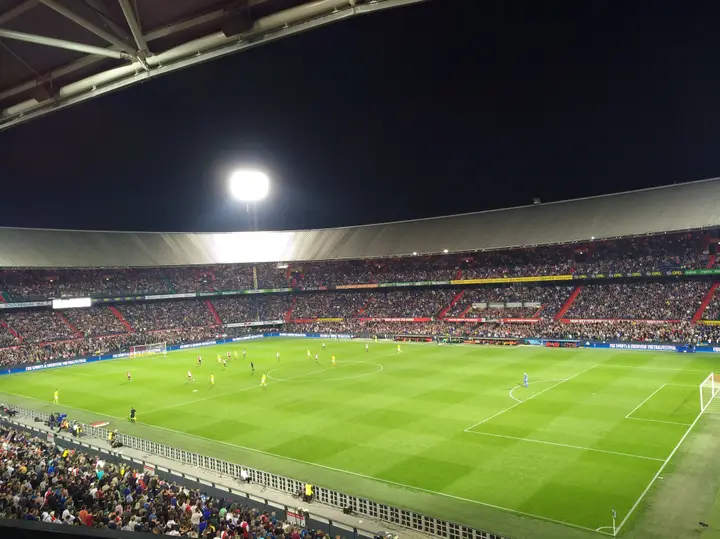
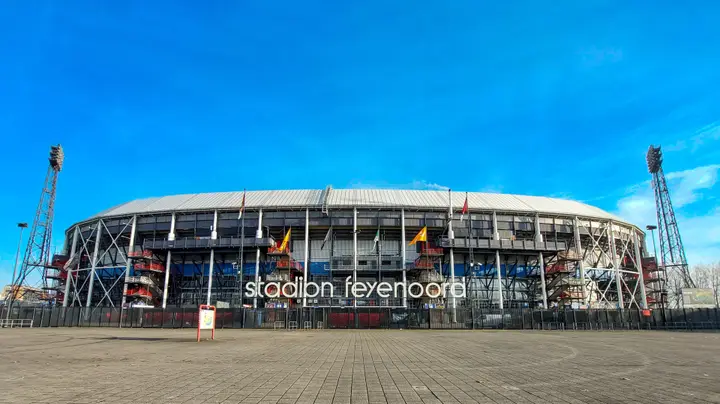
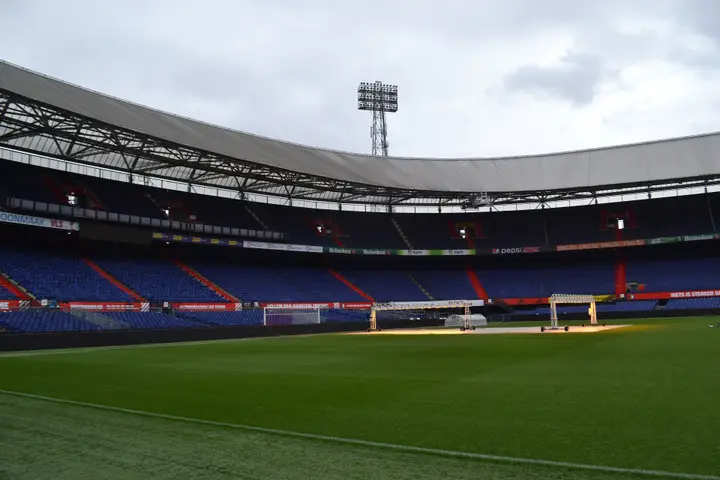
Photo credits
Feyenoord players on the pitch at De Kuip during an Eredivisie match against AZ, with the stands full behind them.: Sebleouf · CC BY-SA 4.0
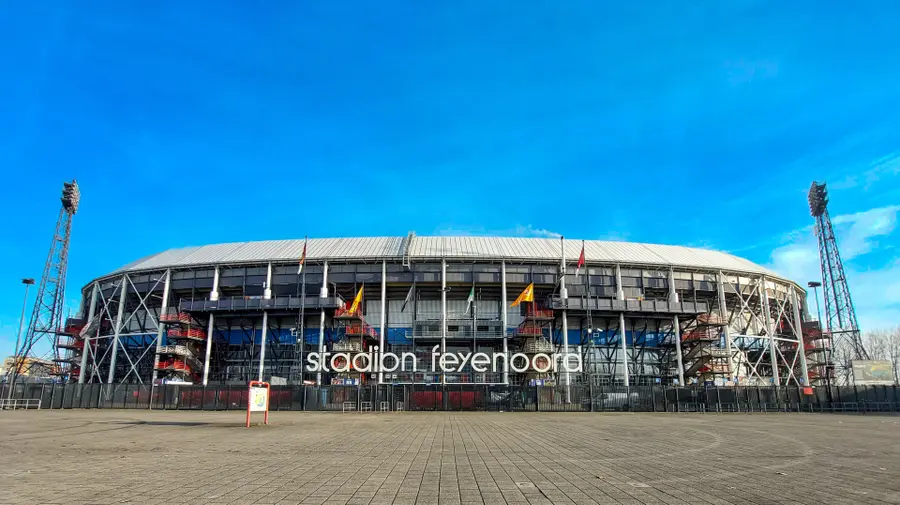
Stadion Feijenoord in bright daylight, its oval stands and roof seen from outside in Rotterdam.: FeyenoordR'dam1908 · CC BY-SA 4.0
The interior of Stadion Feijenoord, with the lower ring of seats and the free-hanging upper tier.: Daniel from Glasgow, United Kingdom · CC BY 2.0
Read reviews on Google Maps We don't show ratings here. See what visitors say on Google Maps.
Frequently asked questions about De Kuip
How many people fit in De Kuip?
Stadion Feijenoord has 51,117 seats, all under the 1994 roof. The 1937 stadium held 65,000, mostly standing, and the record attendance of 69,300 was set in 1949.
What time do matches at De Kuip start and end?
Evening games usually kick off at 17:45 or 20:00 and Sunday afternoon games around 12:30–13:30. A match takes about 100 minutes with half-time, so plan for it to finish roughly two hours after kick-off.
Is De Kuip an all-seater stadium?
Yes. The 1994 renovation removed the standing terraces, and De Kuip now has 51,117 individual seats in two continuous, fully covered rings.
Which seats are best at De Kuip?
Lower-ring seats near the halfway line are closest to the play. The free-hanging upper ring is higher and further away, but has no columns and gives a clear view of the whole pitch.
How do I get to De Kuip by public transport?
Take metro line D or E from Rotterdam Centraal to Maashaven or Rijnhaven and walk about 9 to 12 minutes. Tram 2 also stops at Maashaven.
Where do I park for De Kuip?
Rotterdam has paid parking zones in the city, while P+R sites at the edge are often free. Q-Park advises its garages at Rijnhaven (Pudongstraat 4) or on Kop van Zuid (Posthumalaan 35 / Wilhelminakade 201), followed by the metro to Maashaven or Rijnhaven and a short walk.
Are there still concerts at De Kuip?
No pop concerts are held here now. The stadium hosted shows from 1978, starting with Bob Dylan and Eric Clapton, until 2025, when the city stopped them because of housing planned nearby.
Can I take a tour of De Kuip?
Yes. Guided tours go through the player tunnel and the dressing rooms, let you sit on the manager's bench and show you the pitch from several viewpoints. Book through the official stadium site.
Why is the stadium called De Kuip?
The nickname means 'the tub'. It first appeared in De Maasbode on 28 March 1937, a day after the opening, describing the steep bowl-shaped stands that surround the pitch.
Is De Kuip a protected monument?
Yes. It was declared a Rotterdam monument in 1991, which means the stadium cannot be demolished without permission from the city council.
When did De Kuip open?
It opened on 27 March 1937, after construction finished in 1936. The first match had already been played in the pouring rain earlier that March, before the official ceremony.
Can I eat at De Kuip?
Brasserie de Cuyperij in the Maasgebouw serves lunch and is open to visitors after a guided tour. On match days the stadium's business and hospitality areas are used.
Sources: Official Stadion Feijenoord website (November 21, 2026) · Official architecture page (November 21, 2026) · Maashaven metro station (Dutch Wikipedia) (November 21, 2026) · Q-Park Rotterdam (November 21, 2026) · Official guided-tour page (November 21, 2026) · Stadion Feijenoord (Dutch Wikipedia) (November 21, 2026)