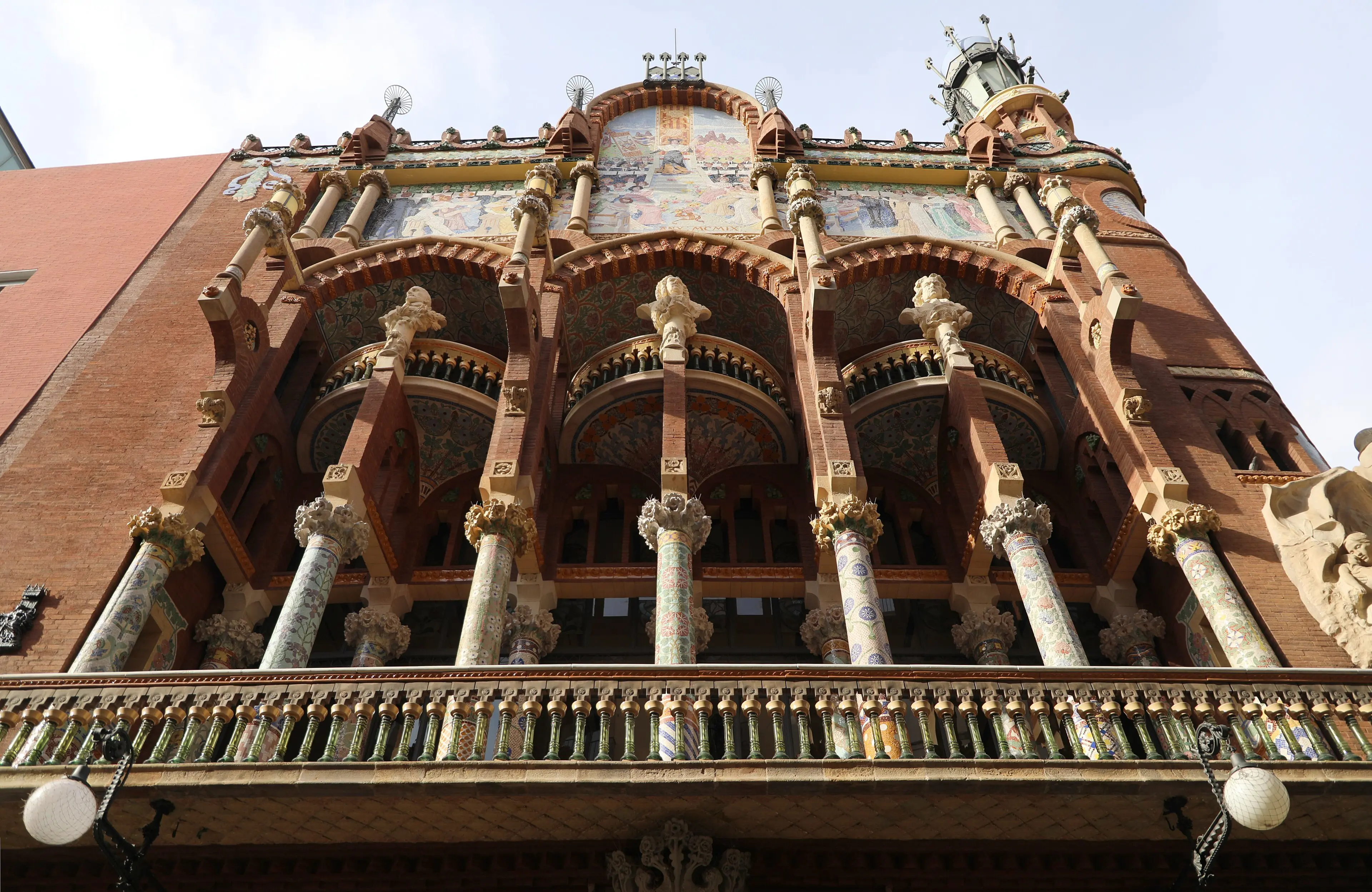
Palau de la Música Catalana in Barcelona
Barcelona's UNESCO-listed modernista concert hall: 2,049 seats in the main hall, a 538-seat Petit Palau, and Urquinaona metro two minutes away.
Photo credits
The ornate exterior terrace and façade of the Palau de la Música Catalana in Barcelona, with its tiled columns and mosaics.: Francesco Bini · CC BY-SA 4.0
Quick answers
- Main hall
- 2,049 seats in five sections
- Address
- C/ Palau de la Música, 4-608003 Barcelona
- Petit Palau
- 538 seats, opened 2004
- Nearest metro
- Urquinaona (L1, L4), about 2 min
- From Arc de Triomf
- 710 m, about 9 min walk
- Closest parking
- Ortigosa garage, about 1 min walk
- Parking rate
- Saba garages €4.20/hour
- Evening shows end
- Around 21:30-23:00 (typical)
Holidays at Palau de la Música Catalana
Open on the holidays: these nights are in the agenda.
- ChristmasEl trencanous de Txaikovski
- ChristmasConcert de Sant Esteve
- New Year's EveNight of Guitar and Flamenco
Palau de la Música Catalana agenda: upcoming events
Tonight, this week and the months ahead at this venue in Barcelona.
Tonight
- Tue24Nov
 from €32Tickets
Tomorrow
- Wed25Nov
 from €39Tickets
This week
- Thu26Nov
 €20Tickets
- Fri27Nov
 €35Tickets
- Fri27Nov
 from €38Tickets
- Sat28Nov
 Candlelight: Tribute to Michael Jackson4 shows:Sat 28 Nov 17:00Sat 28 Nov 21:00Sun 29 Nov 19:00Sun 29 Nov 21:00from €19.50Tickets
- Sat28Nov
 from €30Tickets
- Sun29Nov
 from €10Tickets
- Mon30Nov
 from €30Tickets
Plan your visit to Palau de la Música Catalana
How many people fit in the Palau de la Música Catalana?
The main concert hall holds 2,049 people; the smaller Petit Palau holds 538.
- Main hall
- 2,049 seats
- Petit Palau
- 538 seats
- Gran Teatre del Liceu
- 2,292 seats
- Teatro Poliorama
- 705 seats
The Catalan reference gives the exact breakdown: 688 in the stalls (platea), 321 on the first floor, 910 on the second floor, 82 in the organ galleries and 48 in reserved boxes. English-language descriptions round the same hall to about 2,200 seats.
For scale, Barcelona's opera house the Gran Teatre del Liceu, 0.8 km away, has 2,292 seats. The Teatro Poliorama seats 705 and the Club Capitol 523, both in the same central neighbourhood, and the Petit Palau next door seats 538. The Palau is therefore close to the Liceu in size and much larger than the city's ordinary theatres.
| Venue | Type | Seats | Source |
|---|---|---|---|
| Palau de la Música Catalana, main hall | Concert hall | 2,049 | Catalan Wikipedia |
| Gran Teatre del Liceu, Barcelona | Opera house | 2,292 | Wikidata (area data) |
| Petit Palau, at the Palau | Chamber hall | 538 | Wikipedia |
| Teatro Poliorama, Barcelona | Theatre | 705 | Wikidata (area data) |
| Club Capitol, Barcelona | Theatre | 523 | Wikidata (area data) |
Seating plan: the stalls, the two floors and which seats to choose
The main hall is one auditorium with a stalls floor and two seated levels; there is no standing floor.
- Platea (stalls)
- 688 seats
- First floor
- 321 seats
- Second floor
- 910 seats
- Organ galleries
- 82 seats
- Reserved boxes
- 48 seats
- Stage mouth
- 11 m wide
Seats are distributed as 688 in the platea (stalls), 321 on the first floor, 910 on the second floor, 82 in the organ galleries and 48 in reserved boxes. The second floor is the largest single block; the organ galleries sit closest to the great pipe organ behind the stage. The stage mouth is 11 metres wide.
For a clear view of the stage and the stained-glass skylight, the front stalls and the first floor are usually preferred. The second floor is the biggest block and is often the cheapest way into a popular concert. This is a seated hall: your ticket fixes your seat, so study the seat map of the official seller for your event.
- Want to be close to the performers? Choose the front platea or the first floor.
- Want the whole hall and the skylight in view? The first floor faces the stage directly.
- On a tight budget? The second floor has the most seats and is usually the cheapest level.
- The organ galleries sit beside the pipe organ behind the stage; sightlines there are angled.
Food and drink at the Palau
The Palau has a bar and tapas counter in its foyer, but it is a concert hall rather than a restaurant.
The foyer features a large counter where tapas and beverages are served to concert-goers and visitors touring the building. It sits between massive brick pillars and is lit from behind by stained-glass panes.
The Lluís Millet hall on the second floor is the traditional gathering place before a concert. For a full meal, eat in the Born or Santa Caterina neighbourhoods before you arrive; the foyer counter is best treated as a pre-concert snack and drink.
- In the foyer
- Tapas and drinks counter
- Before the show
- Lluís Millet hall, second floor

Visiting the building outside a concert
The Palau is more than a ticket hall: visitors tour the building, and the Lluís Millet hall on the second floor is described as both a gathering place for concert-goers and a teaching area for visitors on tours.
On a concert night the building opens on the event's own timetable. Check the official site for current guided-tour times and tickets, because opening arrangements for visits change with the programme.
- Guided visits
- Visitors tour the building
- Lluís Millet hall
- Second-floor salon and teaching area
- Concert nights
- Opening follows the event timetable
Getting to the Palau by metro, bus or from the train station
Urquinaona, served by metro lines L1 and L4, is the nearest station: 170 metres from the Palau, about a two-minute walk.
Barcelona Arc de Triomf is the main train station, 710 metres away: walk about nine minutes, or take metro L1 to Urquinaona and walk two minutes from there.
Buses 47, 59 and V15 stop at Via Laietana - Comtal, 80 metres from the venue. More buses stop at Pl Urquinaona (19, 39 and H16) and along Rda. Sant Pere. The Palau is in the narrow streets of the old city, so allow extra time if you are being dropped off by car.
Nearest metro
Urquinaona, L1 and L4
Walk from Urquinaona
About 2 minutes
From Arc de Triomf
9-minute walk, or L1 to Urquinaona
- After a late finish, check the last L1/L4 metro from Urquinaona and the last train from Arc de Triomf in the TMB and Rodalies planners before you go.
Parking near the Palau: garages, addresses and rates
There is no visitor car park at the Palau itself. The closest paid garage is Ortigosa, about 70 metres away (no public rate), and four Saba garages lie within 450 metres, charged at €4.20 an hour, or €4.00 at Saba Catedral.
Saba Bamsa Francesc Cambó under the Santa Caterina market is the nearest of the large garages, about three minutes' walk away, with 643 spaces. Saba Catedral is about four minutes away, Saba Plaça Urquinaona about five and Saba Plaça Catalunya about six. All four are open around the clock.
These are standard hourly tariffs, not a concert flat rate, so check the operator's current price before you travel. The streets around the Palau are narrow and largely pedestrianised; public transport is the simpler choice on a concert night.
| Garage | Address | Walk | Rate |
|---|---|---|---|
| Saba Bamsa Francesc Cambó | Av. de Francesc Cambó, 10, 08003 Barcelona | About 3 min (260 m) | €4.20/hour |
| Saba Catedral | Av. de la Catedral, Plaça d'Antoni Maura, 08002 Barcelona | About 4 min (300 m) | €4.00/hour |
| Saba Plaça Urquinaona | Pl. d'Urquinaona, 08010 Barcelona | About 5 min (410 m) | €4.20/hour |
| Saba Plaça Catalunya | Pl. de Catalunya, s/n, 08002 Barcelona | About 6 min (450 m) | €4.20/hour |
- Book online with the operator in advance if you are driving to a popular concert.
- Ortigosa is only 70 m away but publishes no tariff; the Saba garages quote an hourly price.
- Plaça Catalunya garage has 1,170 spaces, the most of the four, and is the furthest to walk.
About the Palau de la Música Catalana
Designed by Lluís Domènech i Montaner for the Orfeó Català choral society and inaugurated on 9 February 1908, the Palau de la Música Catalana is one of Barcelona's best-known modernista buildings. With the Hospital de Sant Pau it has been a UNESCO World Heritage Site since 1997. Its main concert hall holds 2,049 people across the stalls, two floors, organ galleries and reserved boxes; the Petit Palau, added in 2004, seats 538.
The hall is the only auditorium in Europe lit entirely by natural light during the day: arched stained-glass walls and a skylight designed by Antoni Rigalt fold a gold-and-blue sun into the ceiling. Sculptures of the muses flank the stage and ceramic medallions name composers from Palestrina to Wagner.
Today more than half a million people a year come for symphonic and chamber music, jazz, flamenco and Catalan song. The building stands in the old city, on the corner of Carrer Palau de la Música and Carrer de Sant Pere Més Alt, a short walk from Urquinaona metro.
Visitors can tour the building outside concert times. The Lluís Millet hall on the second floor is a gathering place for concert-goers, and the foyer has a counter serving tapas and drinks.
- Opened
- 9 February 1908
- Architect
- Lluís Domènech i Montaner
- UNESCO
- World Heritage Site since 1997
- Audience
- More than half a million a year
- Address
- C/ Palau de la Música, 4-6, 08003 Barcelona
History and architecture
Lluís Domènech i Montaner designed the Palau for the Orfeó Català, a choral society founded in 1891. It was built between 1905 and 1908, inaugurated on 9 February 1908 and won the architect a Barcelona City Council award in 1909.
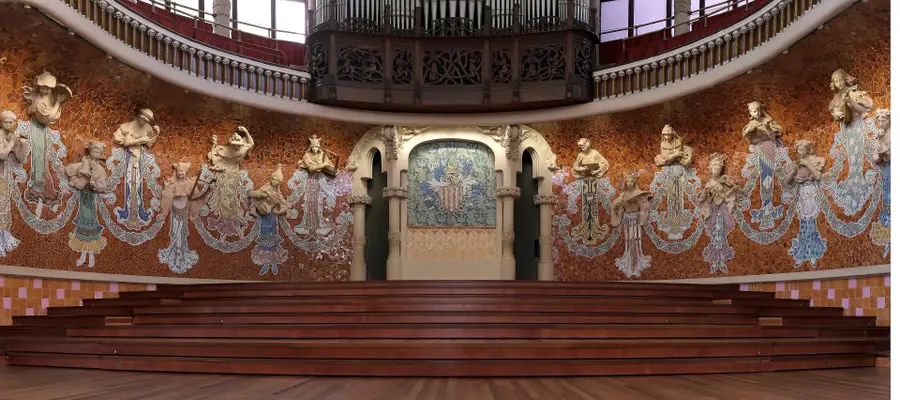
Red brick, iron, mosaics, ceramic tiles and stained glass are used as structural and decorative materials. The façade carries busts of Palestrina, Bach, Beethoven and Wagner, and a sculptural group representing Catalan song. Inside, the concert hall is dominated by a gold-and-blue stained-glass sun, a pipe organ and eighteen muses in mosaic and sculpture.
The building was restored, modernised and extended between 1982 and 1989 under Oscar Tusquets and Carles Díaz, when a six-storey tower with dressing rooms, a library and archives was added. A further restoration ran from 2006 to 2008. The Petit Palau chamber hall opened in 2004 below the square beside the church. UNESCO listed the Palau together with the Hospital de Sant Pau in 1997.
- Built
- 1905-1908
- Inaugurated
- 9 February 1908
- Major restoration
- 1982-1989
- Petit Palau
- Opened 2004
Photos
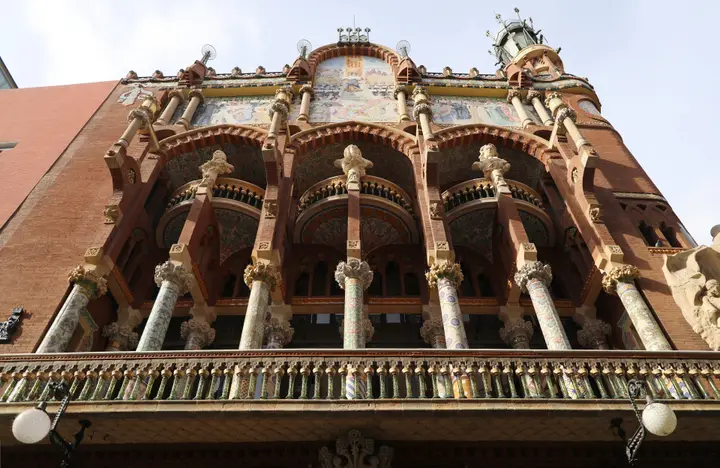
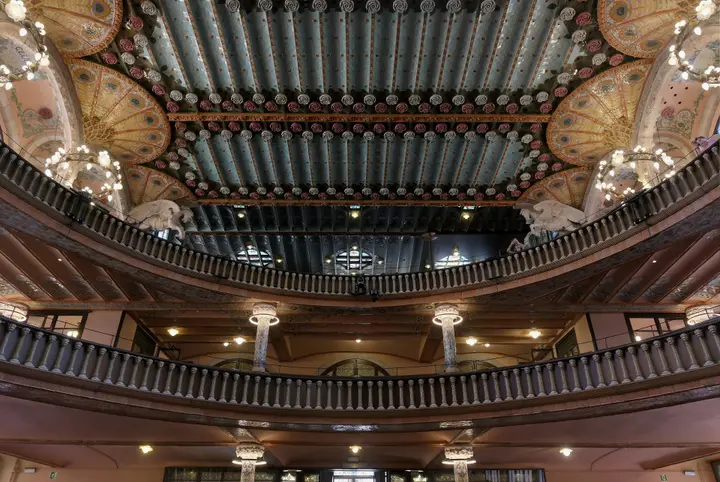
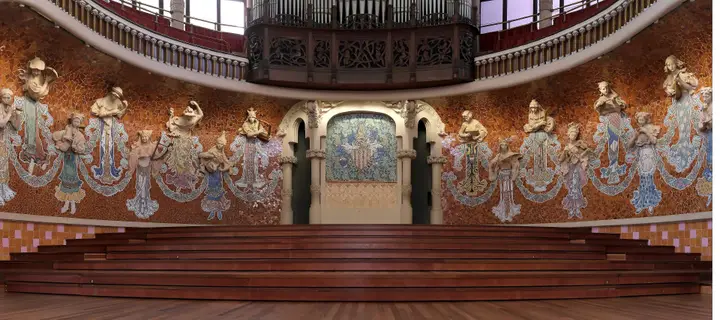
Photo credits
The ornate exterior terrace and façade of the Palau de la Música Catalana in Barcelona, with its tiled columns and mosaics.: Francesco Bini · CC BY-SA 4.0
The two balconies of the concert hall at the Palau de la Música Catalana, above the stalls and facing the stage.: Alvesgaspar · CC BY-SA 4.0
The stage of the Palau de la Música Catalana with the sculpted muses and the arms of Catalonia behind it.: Alvesgaspar · CC BY-SA 4.0
Read reviews on Google Maps We don't show ratings here. See what visitors say on Google Maps.
Frequently asked questions
What time do concerts at the Palau de la Música Catalana start and end?
Evening concerts in the current listings start mostly at 19:00 or 20:00 and, with an interval, finish around 21:30-23:00. Matinees start between 10:00 and 17:30 and end roughly 12:30-19:30. Your ticket gives the exact time for your event.
How many people fit in the Palau de la Música Catalana?
The main concert hall holds 2,049 people: 688 in the stalls, 321 on the first floor, 910 on the second, 82 in the organ galleries and 48 in reserved boxes. Some sources round this to about 2,200. The Petit Palau seats a further 538.
Which seats are best in the main hall?
The front stalls and the first floor give the clearest view of the stage and the stained-glass skylight. The second floor is the largest and usually cheapest block. Every seat is numbered and is fixed by your ticket.
What is the Petit Palau?
The Petit Palau is the 538-seat chamber hall opened in 2004, eleven metres below the square beside the main building. It has variable acoustics for chamber music and spoken word.
Which metro station serves the Palau?
Urquinaona, on lines L1 and L4, is the nearest station at 170 metres, about a two-minute walk. Buses 47, 59 and V15 stop even closer at Via Laietana - Comtal, 80 metres away.
Which train station is closest to the Palau?
Barcelona Arc de Triomf is the nearest main-line station, 710 metres away: about a nine-minute walk, or take metro L1 to Urquinaona and walk two minutes.
Where should I park for a concert?
The nearest paid garage is Ortigosa, 70 metres away, but it publishes no rate. Saba Bamsa Francesc Cambó (Av. de Francesc Cambó 10) is 260 metres away, Saba Catedral 300 metres, Saba Plaça Urquinaona 410 metres and Saba Plaça Catalunya 450 metres.
How much does parking near the Palau cost?
The Saba garages list an hourly tariff of €4.20; Saba Catedral lists €4.00 an hour. These are standard rates rather than a concert flat fee, so check the operator before you travel.
Who designed the Palau and when did it open?
Lluís Domènech i Montaner designed it for the Orfeó Català. It was built between 1905 and 1908 and inaugurated on 9 February 1908.
Is the Palau a UNESCO World Heritage Site?
Yes. It was inscribed in 1997 together with the Hospital de Sant Pau in Barcelona, as part of the modernista architecture of the city.
Can I visit the building without a concert ticket?
Yes, visitors tour the building outside performances, and the second-floor Lluís Millet hall is used as a teaching area on tours. Check the official website for current tour times and tickets.
Is there food inside the Palau?
There is a counter in the foyer serving tapas and beverages to concert-goers and visitors, under the stained-glass panes. It is a bar rather than a full restaurant, so eat beforehand if you want a proper meal.
What makes the concert hall special?
It is the only auditorium in Europe lit entirely by natural light during the day, with arched stained-glass walls and a gold-and-blue skylight by Antoni Rigalt. Eighteen muses, a pipe organ and medallions of composers decorate the stage end.
What is the address of the Palau de la Música Catalana?
The Palau is at C/ Palau de la Música, 4-6, 08003 Barcelona, in the old city near Urquinaona metro. The Petit Palau is in the same building, below the square beside the church.
Sources: Palau de la Música Catalana (Wikipedia) (November 24, 2026) · Palau de la Música Catalana (Viquipèdia) (November 24, 2026) · OpenStreetMap stops, stations and car parks around the Palau (November 24, 2026) · Saba Bamsa Francesc Cambó parking, Barcelona (November 24, 2026)


