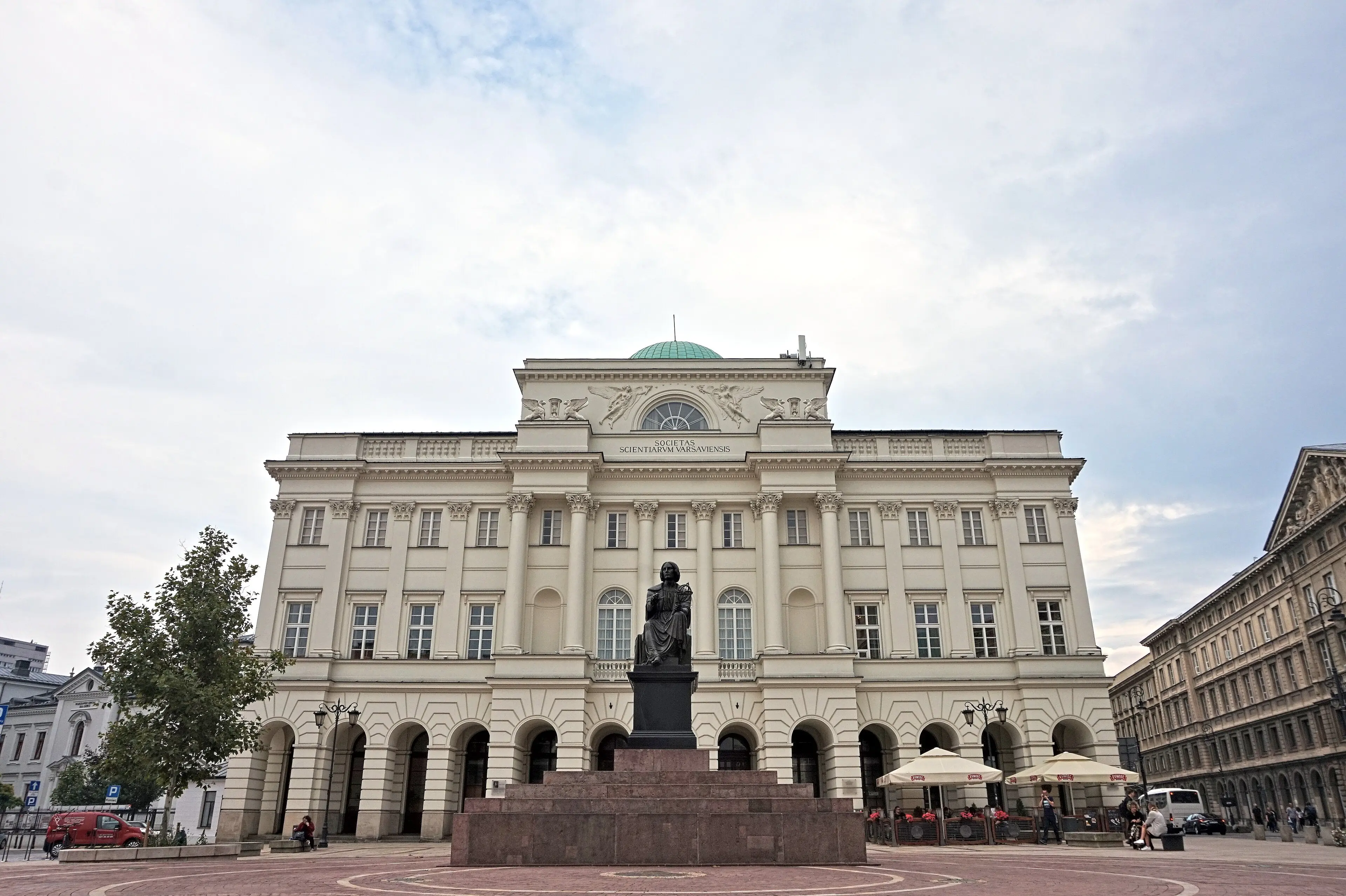
Pałac Staszica in Warszawa
Pałac Staszica is the neoclassical seat of the Polish Academy of Sciences at Nowy Świat 72, where its 200-seat Mirror Hall hosts candlelit concerts and children's shows three minutes from the M2 metro.
Photo credits
The neoclassical front façade of Pałac Staszica on Nowy Świat in Warsaw, with its columned portico: Amelinium · CC BY-SA 4.0
Quick answers
- Main concert room
- Sala Lustrzana, 200 seats
- Address
- Nowy Świat 7200-330 Warszawa
- Other rooms
- 40 to 90 seats each
- Nearest metro
- M2 Nowy Świat-Uniwersytet, 3 min
- From the airport
- Bus 175 to Uniwersytet stop
- Evening concerts
- Usually 18:00 or 20:00 starts
- Children’s concerts
- Morning and early-afternoon matinees
- In the programme
- 26 upcoming events on Evenitto
- Contact
- +48 22 657 27 07
Pałac Staszica agenda: upcoming events
Tonight, this week and the months ahead at this venue in Warszawa.
April 2027
- Sat10Apr
 PLN 100Tickets
Plan your visit to Pałac Staszica
How many people fit in Pałac Staszica?
- Sala Lustrzana
- 200 seats
- Skłodowska-Curie room
- 90 seats
- Round Table room
- 70 seats
The largest room, Sala Lustrzana (the Mirror Hall), seats 200 people. The other halls are much smaller: 90 seats in the Maria Skłodowska-Curie room, 70 at the Round Table, 60 in the Staszic room, 40 in the Kołłątaj room and 70 in the modern room 022. The venue does not publish a single capacity for the whole building.
That makes the Mirror Hall a mid-sized concert room: smaller than Teatr Polski's main auditorium of over 700 seats and the National Philharmonic's 1,072-seat hall, both nearby in central Warsaw.
| Venue / room | Seats | Source |
|---|---|---|
| Pałac Staszica – Sala Lustrzana | 200 | Archiwum PAN exhibition catalogue |
| Pałac Staszica – Maria Skłodowska-Curie room | 90 | Archiwum PAN exhibition catalogue |
| Pałac Staszica – Round Table room | 70 | Archiwum PAN exhibition catalogue |
| Pałac Staszica – Staszic / Kołłątaj / 022 rooms | 60 / 40 / 70 | Archiwum PAN exhibition catalogue |
| Teatr Polski, Warsaw – main auditorium | Over 700 | teatrpolski.waw.pl/sceny-teatru |
| National Philharmonic, Warsaw – concert hall | 1,072 | National Philharmonic venue information |
Where to sit in the Mirror Hall
Mirror Hall
200 seats, the main concert room
Smallest room
Kołłątaj room, 40 seats
Seat choice
Front for closeness, back for an overview
Concerts at Pałac Staszica are seated and take place in rooms of 40 to 200 places; the Mirror Hall, with 200 seats, is the usual concert room. The smaller rooms put every seat close to the performers, while in the Mirror Hall the front seats give the closest view and the seats further back the wider overview of the room.
A numbered row-by-row seat plan is not published for these concert series, so use the section printed on your ticket and ask the ticket seller which part of the hall it covers. Accessible seating is not described on the pages read; contact the organiser if you need a specific place.
- Check the section on your ticket: searches for the hall mention a “sektor A”, but no public map of the sections was found.
- For a child's first concert, the smaller rooms keep the performers close; for a candlelit concert the Mirror Hall is the standard setting.
Food and drink around the palace
Restaurants and cafés line Nowy Świat and Krakowskie Przedmieście directly outside the palace, and the Old Town is about a 20-minute walk away. Menus are often displayed at the entrance and many are available in English.
No restaurant or café inside Pałac Staszica is named on the pages read, so the streets around the building are the practical choice before or after a concert.
Getting to Pałac Staszica by metro, bus or train
The easiest way in is metro line M2 to Nowy Świat-Uniwersytet, a three-minute walk from the palace. Buses stop at Uniwersytet, about 100 m away, and bus 175 comes straight from Chopin Airport.
From Warszawa Centrum, take M1 to Świętokrzyska and change to M2 towards Nowy Świat-Uniwersytet; the walk from that station takes about three minutes. A 20-minute public-transport ticket costs 3.40 PLN and a 70-minute ticket 4.40 PLN.
Parking near Pałac Staszica
There is no visitor car park at the palace itself. Four car parks are mapped within walking distance, the closest about 230 m away. Interparking's Warsaw garages start at 5 zł per hour or 55 zł per day when booked online, with the exact tariff depending on the garage.
Because the palace stands on a busy central street, public transport is the simpler choice for an evening concert.
| Car park | Address | Walk to the palace | Rate |
|---|---|---|---|
| Interparking Piękna 20 | ul. Piękna 20, entrance from ul. Krucza, Warszawa | About 15 min | From 5 zł/hour or 55 zł/day online |
- Nearest car park
- About 230 m, roughly 3 min walk
- Interparking rate
- From 5 zł/hour, 55 zł/day online
What Pałac Staszica is
Pałac Staszica is a neoclassical palace at Nowy Świat 72 in central Warsaw, at the point where Nowy Świat meets Krakowskie Przedmieście. It is the seat of the Polish Academy of Sciences and a venue for classical, candlelit and children's concerts in its historic rooms.
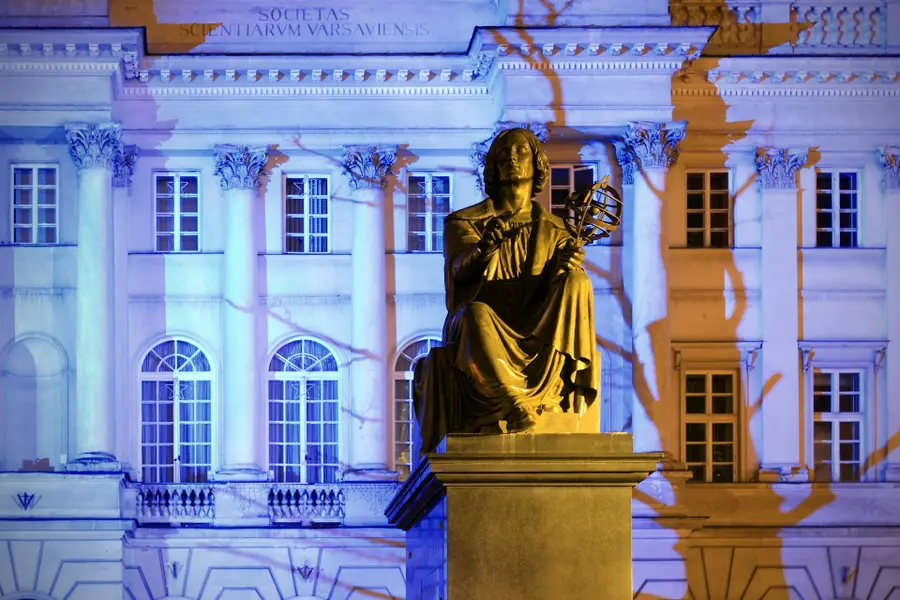
Stanisław Staszic had the building erected in 1820–1823 to a design by Antonio Corazzi for the Royal Society of Friends of Science. The Copernicus monument by Bertel Thorvaldsen was unveiled in front of it in 1830. After the palace became an Orthodox church in the 1890s it gained a Russo-Byzantine façade, which was removed in the 1924–1926 restoration.
Badly damaged in the Second World War, the palace was rebuilt between 1946 and 1950 and became home to the Polish Academy of Sciences. The concert rooms range from the 200-seat Mirror Hall to small rooms of 40 to 90 seats.
The history of Pałac Staszica
Stanisław Staszic commissioned the palace in 1820, and Antonio Corazzi designed the neoclassical building that was completed in 1823 for the Royal Society of Friends of Science. On 11 May 1830 the Copernicus monument by Bertel Thorvaldsen was unveiled in front of it.
After the society was dissolved, the building served a lottery office, a medical academy and a gymnasium. In the 1890s it was rebuilt as an Orthodox church with a Russo-Byzantine façade and an onion dome; Marian Lalewicz returned it to its neoclassical look in 1924–1926.
The palace was damaged in 1939 and almost destroyed in the 1944 Warsaw Uprising. It was rebuilt between 1946 and 1950 under Piotr Biegański and became the seat of the Polish Academy of Sciences.
Photos
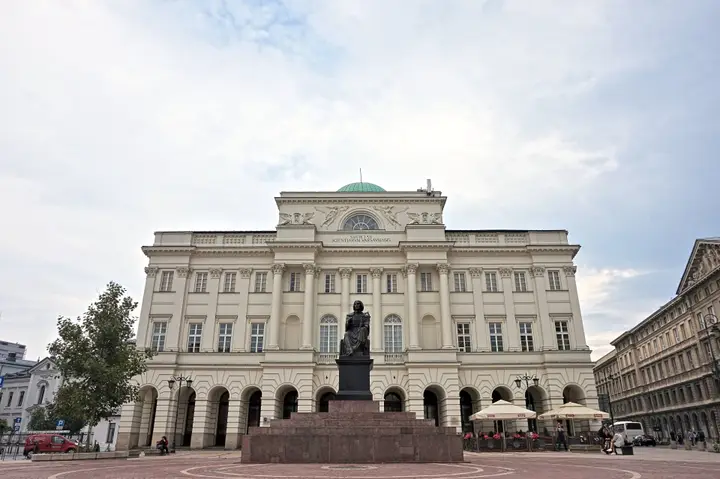
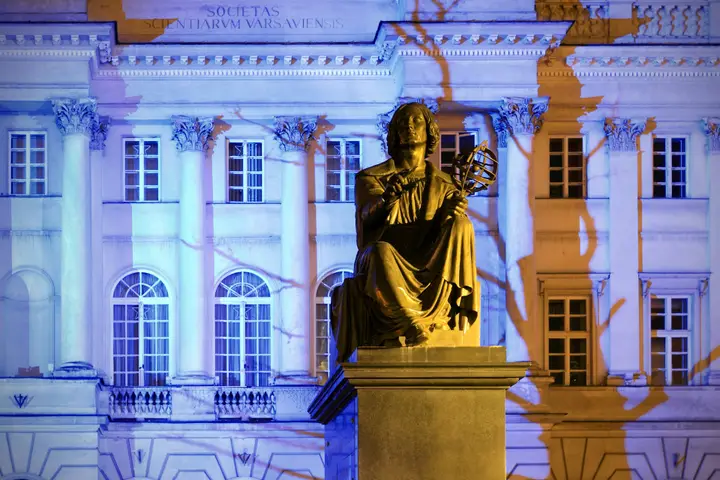
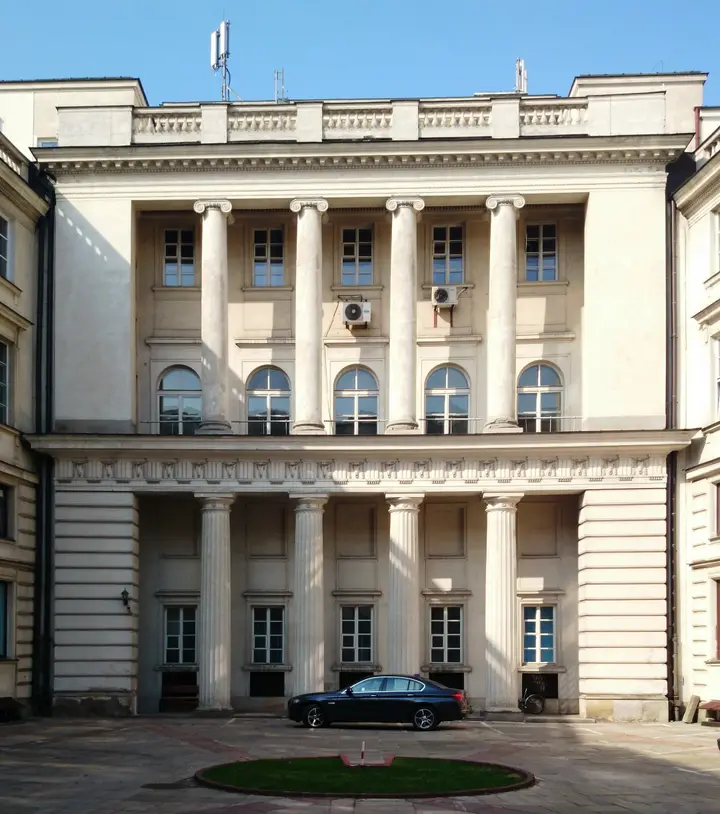
Photo credits
The neoclassical front façade of Pałac Staszica on Nowy Świat in Warsaw, with its columned portico: Amelinium · CC BY-SA 4.0
The bronze Copernicus monument in front of the neoclassical façade of Pałac Staszica in Warsaw: McBartosz · CC BY 3.0
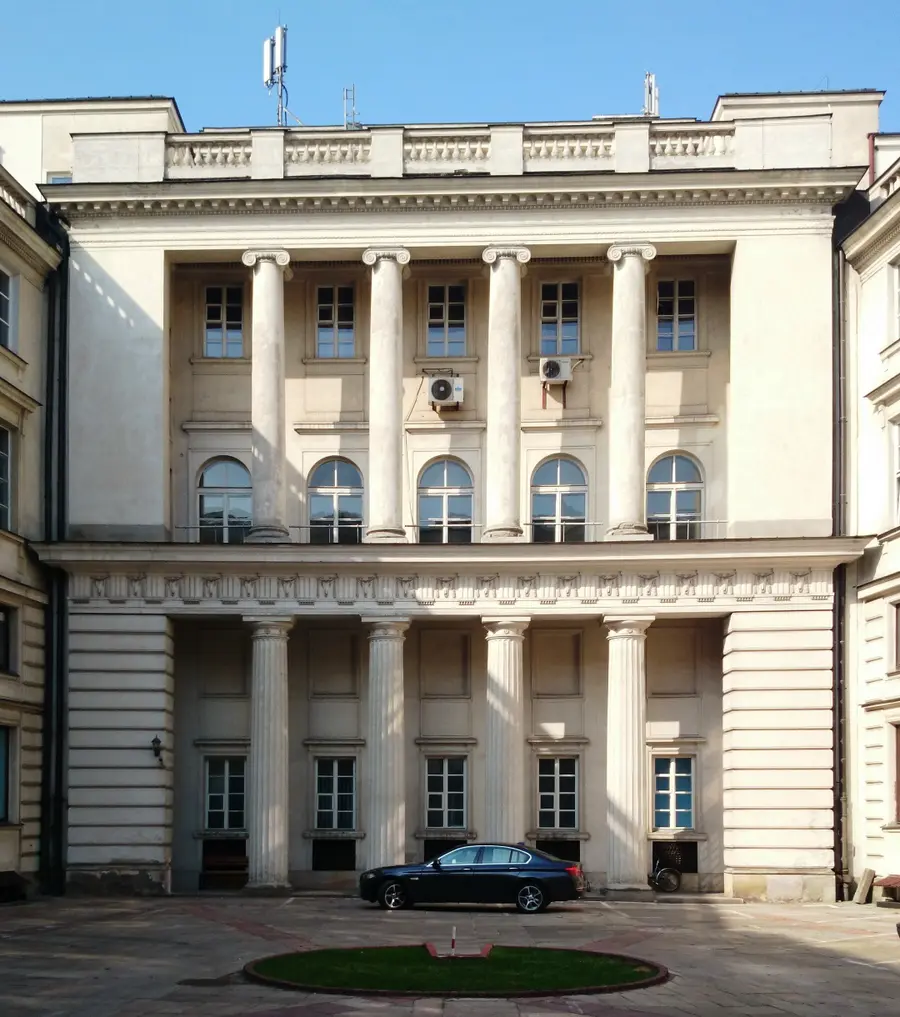
The northern façade of Pałac Staszica's inner courtyard in Warsaw, a reconstruction of the historic Mikulski tenement frontage: Happa · CC BY 3.0
Read reviews on Google Maps We don't show ratings here. See what visitors say on Google Maps.
Frequently asked questions about Pałac Staszica
What is on at Pałac Staszica?
The programme is mainly classical and candlelit concerts in the Mirror Hall, with frequent concerts for children and families in the mornings and early afternoons. Evenitto currently lists 26 upcoming events here.
Where is Pałac Staszica?
It is at Nowy Świat 72, 00-330 Warszawa, where Nowy Świat meets Krakowskie Przedmieście in the Śródmieście district. It is the seat of the Polish Academy of Sciences.
How do I get there by metro?
Take metro line M2 to Nowy Świat-Uniwersytet; the palace is a three-minute walk away, roughly 120 to 214 m from the station. From Warszawa Centrum take M1 to Świętokrzyska and change to M2.
How do I get there from Chopin Airport?
City bus 175 runs from Chopin Airport to the city centre and stops at Uniwersytet, about 100 m from the palace, so the last stretch is a two-minute walk. A single 20-minute ticket costs 3.40 PLN.
Is there parking near Pałac Staszica?
Four car parks are mapped within walking distance and the closest is about 230 m away. Interparking garages in Warsaw start at 5 zł per hour and 55 zł per day when booked online; check the operator for the tariff at the nearest garage.
How many people fit in the Mirror Hall?
The Sala Lustrzana (Mirror Hall) seats 200. The other rooms are smaller: 90 seats in the Maria Skłodowska-Curie room, 70 at the Round Table, 60 in the Staszic room and 40 in the Kołłątaj room.
What time do concerts start and end?
Evening candlelit concerts usually start between 16:00 and 20:30, most often 18:00 or 20:00, and end about 75 minutes later, so a 19:00 show finishes around 20:15. Matinees start around 10:00, 11:00, 13:00 or 15:00 and run about 45 minutes, ending near 11:00, 12:00, 14:00 or 15:45.
Are the concerts suitable for children?
Yes. Regular morning and early-afternoon concerts are aimed at children aged about 5 to 12 and last roughly 45 minutes plus a 15 to 20 minute chance to try the instruments. Evening candlelit concerts are the usual choice for adults.
Which room is the concert in?
Most public concerts are held in the Sala Lustrzana (Mirror Hall), the 200-seat room named for its mirrors. The palace also has the Skłodowska-Curie, Round Table, Staszic and Kołłątaj rooms; check your ticket for the room name.
Can I eat or drink at the venue?
Restaurants and cafés line Nowy Świat and Krakowskie Przedmieście right outside the palace, and the Old Town is about a 20-minute walk away. No in-house restaurant is published on the pages read, so plan to eat nearby.
Does the palace have a cloakroom or a bag policy?
No bag or cloakroom rules are published on the pages read for these concerts. If you are bringing a large bag or need to store a coat, contact the organiser before the show rather than assuming there is a cloakroom.
Is the palace accessible by public transport?
Yes. Metro M2 stops at Nowy Świat-Uniwersytet three minutes away, buses stop at Uniwersytet about 100 m from the entrance, and bus 175 comes from Chopin Airport. Travelling by public transport is easier than parking in this central street.
What is the history of the building?
Stanisław Staszic commissioned the neoclassical palace, designed by Antonio Corazzi and built in 1820–1823 for the Royal Society of Friends of Science. It became an Orthodox church in the 1890s, was restored after 1924, was badly damaged in the Second World War and rebuilt in 1946–1950; today it houses the Polish Academy of Sciences.
Sources: Pałac Staszica w Warszawie (Wikipedia, pl) (November 26, 2026) · Archiwum PAN, exhibition catalogue of Pałac Staszica (November 26, 2026) · PolGEC, venue information (IGF PAN) (November 26, 2026) · Interparking Warszawa (November 26, 2026) · ESPP 2025, venue and logistics (IFiS PAN) (November 26, 2026) · Twoje-Miasto Warszawa: Pałac Staszica – Sala Lustrzana (November 26, 2026)


