Salle Pleyel in Paris
Salle Pleyel is a 2,036-seat Art Deco concert hall in Paris, three minutes on foot from Ternes metro, with doors opening an hour before shows.
Photo credits
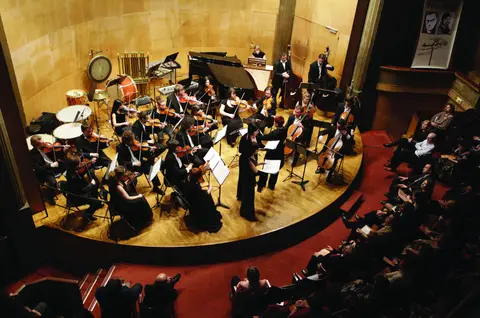
The stage and seated audience during a performance in the main hall of Salle Pleyel, Paris.: Pline · CC BY-SA 3.0 · Cropped
Quick answers
- Capacity
- 2,036 seated · 2,503 seated/standing
- Address
- 252 Rue du Faubourg Saint-Honoré75008 Paris
- Nearest metro
- Ternes, line 2 · 3 min walk
- From central Paris
- Charles de Gaulle–Étoile, RER A · 8 min walk
- Closest parking
- Indigo Hoche, 18 av. Hoche · €4.80/hour
- Doors
- Open one hour before the show
- End time
- Usually before midnight
- Bags
- Under 10 L · backpacks to the cloakroom
- Contact
- 01 86 47 68 43
Salle Pleyel agenda: upcoming events
Tonight, this week and the months ahead at this venue in Paris.
Last night at Salle Pleyel: Folie's





Plan your visit to Salle Pleyel
How many people fit in Salle Pleyel?
Salle Pleyel holds 2,036 people when everything is seated and 2,503 in a seated/standing layout.
- All seated
- 2,036
- Seated/standing
- 2,503
- Salle Debussy (historic)
- About 150 seats
- Salle Chopin (historic)
- About 509 seats
The difference comes from the floor in front of the stage: for standing shows extra people fit where seats would otherwise be. The building also once had a 150-seat Salle Debussy and a 509-seat Salle Chopin, used for chamber music before the 2005-06 rebuild; those rooms now serve the main hall rather than hosting separate sold concerts.
In seated configuration Salle Pleyel is a little larger than the Olympia nearby, though Olympia holds more standing spectators. It is roughly a third of the size of the Zénith de Paris, the city's biggest indoor arena.
| Venue | Type | Maximum capacity |
|---|---|---|
| Salle Pleyel, Paris | Concert hall | 2,036 seated; 2,503 seated/standing |
| Olympia, Paris | Music hall | 1,772–1,996 seated; 2,824 standing |
| Zénith de Paris | Indoor arena | 6,804 maximum |
Seating plan: parterre, balconies and the best seats
The main hall has a parterre and two balconies. All seats are numbered, so choose your place when you book.
Parterre
1,030 seats in three blocks
First balcony
397 seats
Second balcony
327 seats
Side balconies
Four, 19 seats each
After the 2005-06 renovation the parterre held 1,030 seats in three blocks, with 397 seats on the first balcony and 327 on the second. Four single-row side balconies of 19 seats each were added to improve the sound around the room.
For a clear, central view choose a seat in the middle of the parterre or the front rows of the first balcony. The second balcony is further from the stage but usually cheaper. The exact layout, block numbers and any standing area are set by the organiser, so check the seat map from the seller for your show.
Bags, cloakroom, food and wifi
Bags over 10 litres are not admitted; smaller bags and backpacks go into the paid cloakroom.
The cloakroom and left luggage service costs €3 per item, paid in cash or by card. Laptops and backpacks must be left there, and a small bag under 10 litres may be checked and then stored. Food is not allowed in the main hall, but a small snack may be eaten in the foyers; cans and bottles are refused at the door.
Wifi is free throughout the building and there are no guided tours.
- Bag limit
- 10 litres
- Cloakroom
- €3 per item, cash or card
- Food
- Small snacks in the foyers only
- Wifi
- Free
Accessibility at Salle Pleyel
There is a dedicated accessible entrance where staff escort you to the lifts and your seat.
Salle Pleyel welcomes visitors with reduced mobility. Enter through the signed dedicated door, where staff take you to the lifts. Accessible seats are held for each performance and cannot be booked online or through other ticket networks.
To book, call the reservation service on 01 86 47 68 43 and explain your situation. Companions also need a ticket. Tell the venue in advance if your needs have changed since you bought the ticket.
- Accessible entrance
- Dedicated, signed door
- Booking
- 01 86 47 68 43
- Companions
- Need their own ticket
- Wheelchair and reduced-mobility seats are reserved for each show; book by phone, not online.
Age limits, photography and house rules
Children under six are not admitted to normal amplified shows, and filming or photography is forbidden.
Under-sixes are refused entry to events not aimed at young children because of the high sound levels; under-16s arriving without an adult need a signed discharge. Every child needs a ticket, and free earplugs are available at the cloakroom. Guide dogs are the only animals allowed.
Smoking is forbidden in the building, and photos, video and phone use in the hall during a show are not allowed. Leaving the hall during a performance means you cannot return to your seat.
- Minimum age
- 6 for normal shows
- Earplugs
- Free at the cloakroom
- Photography
- Forbidden in the hall
- Animals
- Guide dogs only
Getting to Salle Pleyel by metro, bus or RER
Ternes on metro line 2 is the nearest station, 0.211 km from the hall: about a three-minute walk.
The venue lists metro line 2 at Ternes, RER A and metro lines 1 and 6 at Charles de Gaulle–Étoile, buses 43 and 93 at Hoche Saint-Honoré and buses 30 and 31 at Place des Ternes. Coming from a main Paris station, take the RER A to Charles de Gaulle–Étoile and walk, or change to line 2 for Ternes.
A taxi stand is at 272 Rue du Faubourg Saint-Honoré. After a concert the metro and bus stops around Place des Ternes get busy, so allow a few extra minutes.
Parking at Salle Pleyel: garages and rates
Four paid car parks are close to the hall; all are open 24 hours a day, seven days a week.
Indigo Hoche is the closest of the official car parks, with a vehicle entrance at 18 Avenue Hoche. Indigo Wagram, the Ternes car park and Haussmann Berri are the other options. Only the prices displayed at each entrance are charged, so check the board on arrival.
Two-wheeled vehicles can park for free in several spots around the hall or in the paid car parks nearby.
| Car park | Address | Walk | Rate |
|---|---|---|---|
| Indigo Hoche | 18 Avenue Hoche, 75008 Paris | 4 min | €2.40/30 min; €4.80/1 h; €14.40/3 h |
| Indigo Wagram | 22 bis Avenue de Wagram, 75008 Paris | 6 min | Rates posted at the entrance |
| Parking Ternes | 38 Avenue des Ternes, 75008 Paris | 5 min | €1.25/30 min; €5.00/1 h; €15.00/3 h |
| Haussmann Berri | Opposite 155 boulevard Haussmann, 75008 Paris | 9 min | €1.20/15 min; €4.80/1 h; €14.40/3 h |
- Indigo Hoche
- 18 Avenue Hoche · €4.80 per hour
- Indigo Wagram
- 22 bis Avenue de Wagram
- Ternes car park
- 38 and 4 Avenue des Ternes
- Haussmann Berri
- Opposite 155 Boulevard Haussmann
About Salle Pleyel Paris
Salle Pleyel is an Art Deco concert hall at 252 Rue du Faubourg Saint-Honoré in Paris's 8th arrondissement, between Avenue Hoche and Place des Ternes. It opened on 18 October 1927 as a symphony hall built around the ideas of the pianomaker Gustave Lyon, and its facade and foyer were restored in their original Art Deco style.
Today the hall hosts amplified pop, rock, jazz and world music, dance and musical shows rather than the symphony concerts that filled it until 2015. The main hall holds 2,036 people seated or 2,503 in a seated/standing layout, with a parterre and two balconies around a stage that was enlarged in the 2005-06 rebuild.
Doors open one hour before the performance, and the venue advises arriving at least 30 minutes before the time on your ticket. Most shows finish before midnight.
- Opened
- 18 October 1927
- Style
- Art Deco
- Original use
- Symphony concerts

History of Salle Pleyel
Opened in 1927, Salle Pleyel was Paris's great symphony hall and switched to amplified music in 2015.
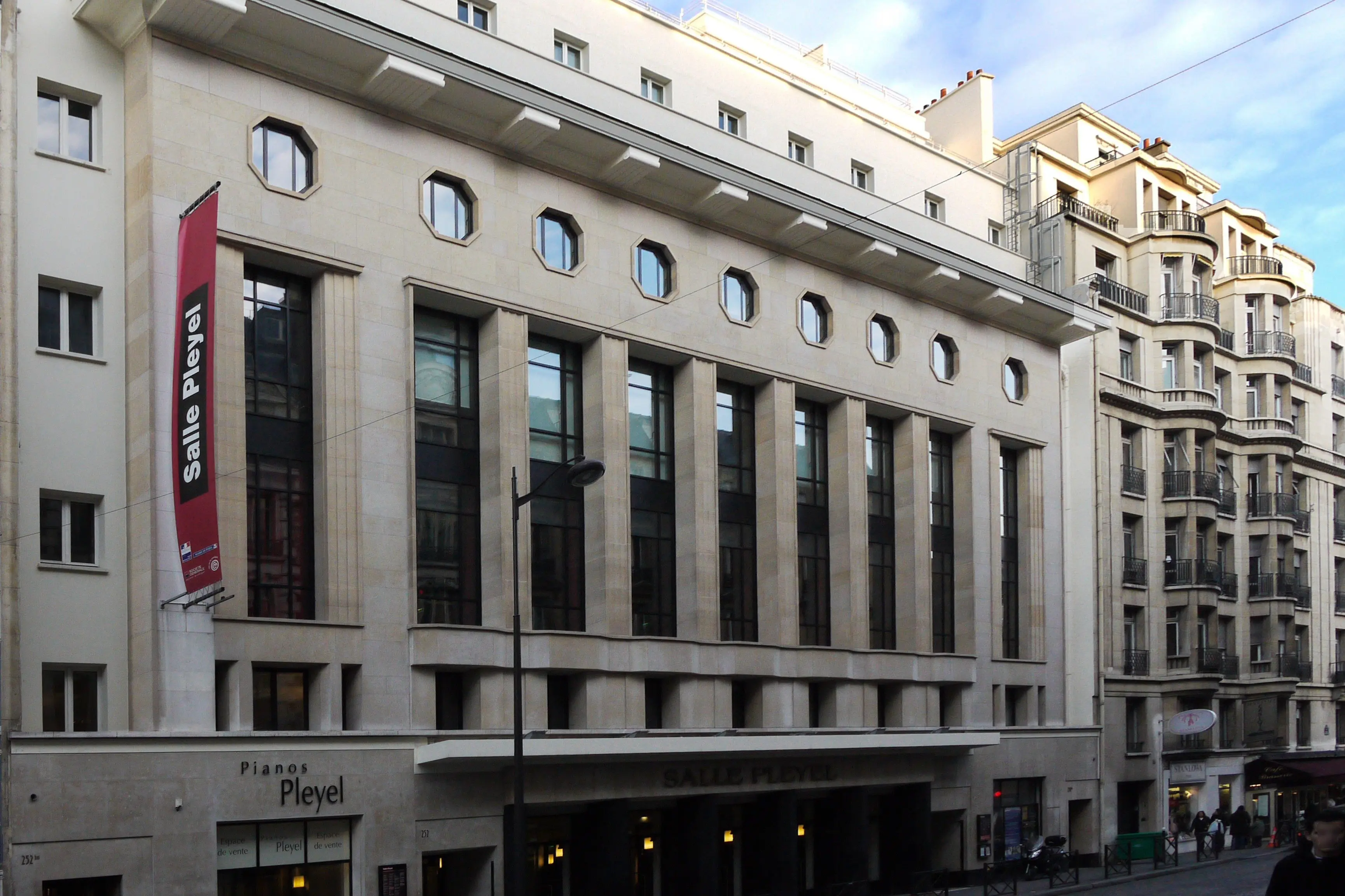
The pianomaker Gustave Lyon commissioned the hall, which was inaugurated on 18 October 1927 and designed around acoustic principles rather than decoration. Its white and black facade, twelve-column vestibule and mosaic rotunda are typical of the Art Deco style.
The hall was rebuilt in 2005-06 and changed again in 2016, when the classical programme ended and the venue turned to pop, rock, jazz and amplified music.
- Opening
- 18 October 1927
- Architect
- Gustave Lyon and collaborators
- Style
- Art Deco
Photos

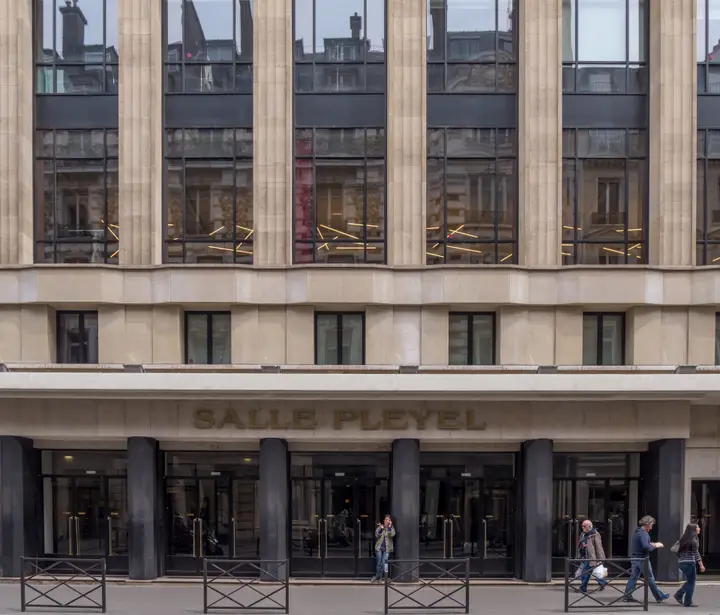
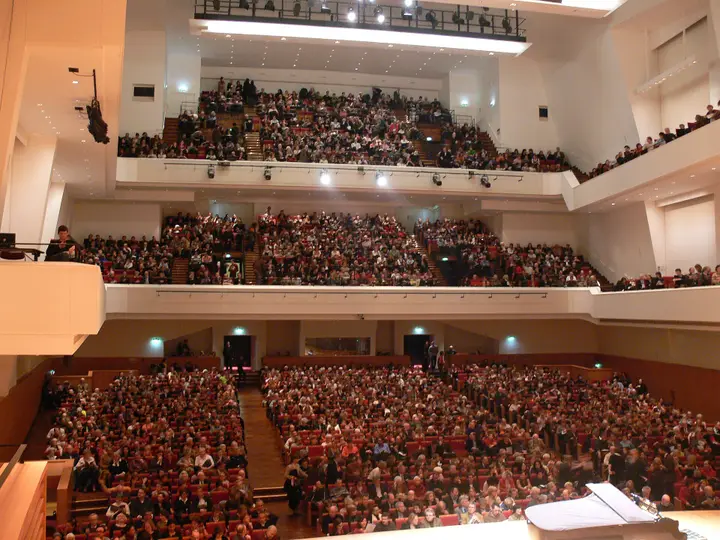
Photo credits
The stage and seated audience during a performance in the main hall of Salle Pleyel, Paris.: Pline · CC BY-SA 3.0 · Cropped
The Art Deco facade of Salle Pleyel on Rue du Faubourg Saint-Honoré in Paris.: Ermell · CC BY-SA 4.0
Salle Pleyel, the concert hall in Paris's 8th arrondissement.: Andreas Praefcke · CC BY-SA 3.0
Read reviews on Google Maps We don't show ratings here. See what visitors say on Google Maps.
Frequently asked questions
What time do shows at Salle Pleyel start and end?
Most evening concerts start at 20:00, with some at 19:00 or 19:30, and matinees often start around 15:00. Doors open one hour before the start. End times vary, but the venue says most shows finish before midnight, typically around 23:00 for an evening concert.
How many people fit in Salle Pleyel?
The main hall holds 2,036 people when fully seated and 2,503 in a seated/standing layout. The parterre has 1,030 seats, the first balcony 397 and the second 327.
Which metro station is best for Salle Pleyel?
Ternes on line 2 is nearest, about three minutes on foot. Charles de Gaulle–Étoile (RER A, metro 1 and 6) is a longer walk but connects to the rest of Paris.
Where can I park near Salle Pleyel?
Four paid car parks are close: Indigo Hoche (18 Avenue Hoche), Indigo Wagram (22 bis Avenue de Wagram), Parking Ternes (38 Avenue des Ternes) and Haussmann Berri. All are open 24/7; only the prices shown at the entrance apply.
Can I bring a backpack to Salle Pleyel?
No. Bags over 10 litres and backpacks are not allowed inside. Leave them at the paid cloakroom, which also takes laptops and costs €3 per item.
Is there a cloakroom at Salle Pleyel?
Yes. The paid cloakroom and left luggage service costs €3 per item, payable in cash or by card. Backpacks, laptops and small bags may be left there.
Can I take photos or film the concert?
No. Cameras, video recording and phone use in the hall are forbidden, and you may be asked to leave if you ignore the rule.
Are children allowed at Salle Pleyel?
Children under six are not admitted to normal amplified shows, and every child needs a ticket. Under-16s without an adult need a signed discharge. Free earplugs are available at the cloakroom.
Can I bring food or drinks?
No cans or bottles and no food in the main hall. A small snack is allowed in the foyers only.
Is Salle Pleyel accessible for wheelchair users?
Yes. Use the dedicated signed entrance, where staff take you to the lifts and your seat. Accessible places are reserved for every performance.
How do I book accessible seats?
Call the reservation service on 01 86 47 68 43, from Monday to Saturday 10 h à 19 h. Accessible tickets cannot be bought online, and companions need their own ticket.
Is there wifi at Salle Pleyel?
Yes, wifi is free throughout the venue. There are no guided tours of the building.
What time do the doors open?
On show days the doors open one hour before the performance unless the event page says otherwise. Arrive at least 30 minutes before the time printed on your ticket.
Sources: Salle Pleyel, Wikipedia (November 19, 2026) · Official travel information (November 19, 2026) · Official parking information (November 19, 2026) · Official FAQ (November 19, 2026) · Official accessibility information (November 19, 2026) · Official safety rules (November 19, 2026)