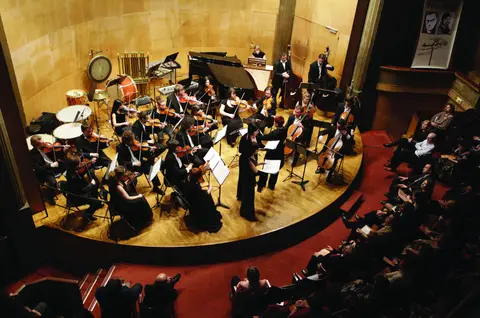
La Philharmonie de Paris in Paris
La Philharmonie de Paris is Jean Nouvel's 2,400-seat concert hall in the Parc de la Villette, with a metro line 5 station at the door and three Q-Park garages nearby.
Photo credits
The Philharmonie de Paris and the adjoining Cité de la musique seen from La Villette, with the Philharmonie's aluminium-clad, hill-shaped facade.: Guilhem Vellut from Paris, France · CC BY 2.0
Quick answers
- Main hall
- Grande salle Pierre Boulez, 2,400 seats
- Address
- 221, Avenue Jean Jaurès75019 Paris
- Nearest stop
- Porte de Pantin, metro 5 and tram T3b
- From Gare du Nord
- Metro 5 direct, five stops
- Closest parking
- Q-Park Philharmonie, 185 bd Sérurier
- Bags
- No luggage or travel bags admitted
- Last metro, Sun–Thu
- 00:50 towards Place d’Italie
- Tickets
- Book ahead; one price per show
- Contact
- +33 1 44 84 44 84
La Philharmonie de Paris agenda: upcoming events
Tonight, this week and the months ahead at this venue in Paris.
Last night at La Philharmonie de Paris: Hassan Hajjaj + Acid Arab
May 2027
- Wed5May
 from €13Tickets
- Mon10May
 from €13Tickets
- Tue11May
 from €13Tickets
- Wed12May
 from €13Tickets
- Fri14May
 from €12.43Tickets
- Fri14May
 from €13Tickets
- Fri14May
 €35Tickets
- Tue18May
 from €13Tickets
- Wed19May
 from €13Tickets
- Thu20May
 Dorian Wood2 shows:Thu 20 MayFri 21 Mayfrom €20Tickets
- Fri21May
 €24Tickets
Plan your visit to La Philharmonie de Paris
How many people fit in La Philharmonie de Paris?
- Grande salle Pierre Boulez
- 2,400 seats
- Layout
- Terraces around the stage
- Furthest seat
- At most 32 m from the conductor
Up to 2,400 people fit in the Grande salle Pierre Boulez, the Philharmonie's main concert hall. That puts it close to the Berlin Philharmonie and a little above the Elbphilharmonie's main hall in Hamburg, and makes it larger than the 1,913-seat Salle Pleyel elsewhere in Paris.
These are figures for the main hall only. The building also contains smaller rehearsal and formation rooms, whose seats are not added to the hall's total.
| Venue | City | Seats | Source |
|---|---|---|---|
| Philharmonie de Berlin | Berlin | 2,440 | Wikipedia: Philharmonie de Berlin |
| Grande salle Pierre Boulez, Philharmonie de Paris | Paris | 2,400 | Wikipedia: Philharmonie de Paris |
| Elbphilharmonie, Großer Saal | Hamburg | About 2,100 | Wikipedia: Elbphilharmonie |
| Salle Pleyel | Paris | 1,913 | Wikipedia: Salle Pleyel |
Seating plan: choosing your seat in the Grande salle
The 2,400 seats rise in terraces that wrap around the stage, following the Berlin Philharmonie model rather than a traditional shoebox hall. There is no single seat facing a fixed podium from straight ahead.
Layout
Terraces surrounding the stage
Furthest seat
32 metres from the conductor
Organ
Rieger organ, 6,055 pipes
Because the audience surrounds the orchestra, seats at the sides and rear look at the performers from an angle but stay close: even the furthest seat is at most 32 metres from the conductor. Concerts here are often full, and the acoustics were designed first and foremost for symphonic music.
The great symphony organ sits behind the orchestra. Seats near it put you closest to the organ sound; seats in the blocks directly facing the stage give the most straightforward view of the conductor. The venue sets one ticket price per show and offers a number of reduced-price places.
- Want the clearest view of the conductor? Choose a block facing the stage.
- Side and rear terraces still sit within 32 metres of the orchestra, so the sound stays close.
- The organ is behind the orchestra; seats nearby hear it most directly.
- There is one price per show and a number of reduced-price places; the exact categories are on the official ticket page.
Bags, cloakroom and security at the Philharmonie
Under the reinforced Vigipirate plan, luggage and travel bags are no longer admitted to the halls or to the cloakrooms. Visitors are asked to arrive at the entrances in advance so the security checks can be completed before the concert.
- Bag rule
- No luggage or travel bags
- Arrival
- Come early for entrance checks
Accessibility at La Philharmonie de Paris
People with reduced mobility and disabled visitors can use all the spaces on the site, and the Philharmonie's car park includes 15 spaces managed by the venue itself. Volunteers can meet you near the approaches and help you find your way to your activity, but the welcome team is not permitted to give physical assistance.
Deaf and hard-of-hearing visitors can reach the services by phone through the Acceo interface, with sign-language interpreting, LPC or live subtitling.
- Accessible spaces
- All areas of the site
- Parking
- 15 spaces run by the Philharmonie
- Escort
- Volunteer help, book at least 48h ahead
- Deaf visitors
- Acceo: LSF, LPC and live subtitling
- Request a volunteer escort at least 48 hours in advance on 01 44 84 44 84 (option 1) or by email to accessibilite@philharmoniedeparis.fr.
- Wheelchair spaces in the car park are managed by the Philharmonie; other bays are managed by Q-Park.
Food and drink at the Philharmonie
The Philharmonie building has its own restaurant, so you can eat on site before an evening concert. The surrounding Parc de la Villette and the adjoining Cité de la musique add further places to eat and drink in the neighbourhood.
Restaurant opening follows the venue's programme rather than a fixed daily timetable, so check the official site before planning a pre-concert meal.
- Inside the building
- A restaurant
- Hours
- Follow the venue's programme
Getting to the Philharmonie by metro, tram, bus or train
Porte de Pantin is the stop for the Philharmonie: metro line 5, tram T3b and buses 75 and 151 all serve it, and it is a short walk to the entrance. Metro line 5 runs direct from Gare du Nord in five stops and from Gare de l’Est in six; from RER E Pantin, bus 151 reaches the venue in a few stops.
After a late concert, the last metro 5 from Porte de Pantin leaves at 00:50 towards Place d’Italie and 01:07 towards Bobigny from Sunday to Thursday. On Fridays and Saturdays those times are 01:50 and 02:07. A G7 taxi rank operates after more than 120 selected concerts, a few metres to the right past the entrance hall.
Main metro line
Line 5, Porte de Pantin
From Gare du Nord
Direct, five stops
From Gare de l’Est
Direct, six stops
From RER E Pantin
Bus 151, a few stops
Last metro, Sun–Thu
00:50 and 01:07
Last metro, Fri–Sat
01:50 and 02:07
- Arrive early: reinforced Vigipirate checks are in place at the entrances.
- Look for the 'Taxi G7' mention in the event listing if you plan to take the rank after the show.
- Check the RATP or SNCF planner for the last service on the day of your concert; holiday timetables differ.
Parking at La Philharmonie de Paris: three Q-Park garages
The Philharmonie's own underground car park opens straight into the building. Reservations are taken on q-park.fr up to two hours before you arrive.
| Car park | Address | Walk | Rate |
|---|---|---|---|
| Parking Philharmonie (Q-Park) | 185 boulevard Sérurier, 75019 Paris | 5 min | Current rate on q-park.fr at booking |
| Cité de la musique – La Villette | Avenue Jean-Jaurès, 75019 Paris | 4 min | Current rate on q-park.fr at booking |
| Cité de la musique – Conservatoire | Rue Adolphe Mille, 75019 Paris | 8 min | Current rate on q-park.fr at booking |
- On-site car park
- 564 car spaces, 15 reduced-mobility bays
- Booking
- q-park.fr, up to two hours ahead
- South exit
- Lifts direct to the Grande salle
- Take the south exit of the Philharmonie car park for the lifts directly serving the Grande salle Pierre Boulez.
- Two coach drop-off points: boulevard Sérurier by the Philharmonie and avenue Jean-Jaurès by the Fontaine aux Lions. Paid coach parking is only through boulevard Macdonald (Porte de la Villette).
- There are 90 spaces for two-wheel vehicles at the Philharmonie car park and 10 at Cité de la musique – La Villette.
- The official visitor page publishes no fixed parking tariff; the current rate is shown when you reserve on q-park.fr.
Which building is my concert in?
- Venue layout
- Two adjoining, separate buildings
- Philharmonie hall
- Grande salle Pierre Boulez, 2,400 seats
| Building | What is inside | Address |
|---|---|---|
| Philharmonie de Paris | Grande salle Pierre Boulez (2,400 seats), exhibitions, rehearsal rooms, restaurant | 221 avenue Jean-Jaurès, 75019 Paris |
| Cité de la musique | Concert halls, Musée de la musique, médiathèque | 221 avenue Jean-Jaurès, 75019 Paris |
About La Philharmonie de Paris
The Philharmonie opened on 14 January 2015 in the south-east of the Parc de la Villette, opposite the Grande Halle and beside the Cité de la musique. Its aluminium-clad, hill-shaped shell was designed by Ateliers Jean Nouvel after an international competition won in 2007.
It is a working music centre rather than a single hall: the Grande salle Pierre Boulez sits alongside exhibition spaces, rehearsal rooms, studios, a restaurant and a dedicated area for children. Five ensembles are in residence, including the Orchestre de Paris.
- Opened
- 14 January 2015
- Architect
- Ateliers Jean Nouvel
- Resident orchestra
- Orchestre de Paris
- Exhibition space
- About 800 m²
History of the Philharmonie de Paris
A symphony hall for Paris was proposed in the 2000s. Ateliers Jean Nouvel won the international design competition in 2007, construction started in September 2009 and the building opened on 14 January 2015 with a concert by the Orchestre de Paris.
The great symphony organ, built by Rieger Orgelbau with 6,055 pipes, was inaugurated on 6 February 2016. The Philharmonie des enfants, a hands-on space for children aged 4 to 10, opened in September 2021.
- Competition won
- April 2007
- Construction began
- September 2009
- Opened
- 14 January 2015
- Organ
- 6,055 pipes, inaugurated 6 February 2016
Photos


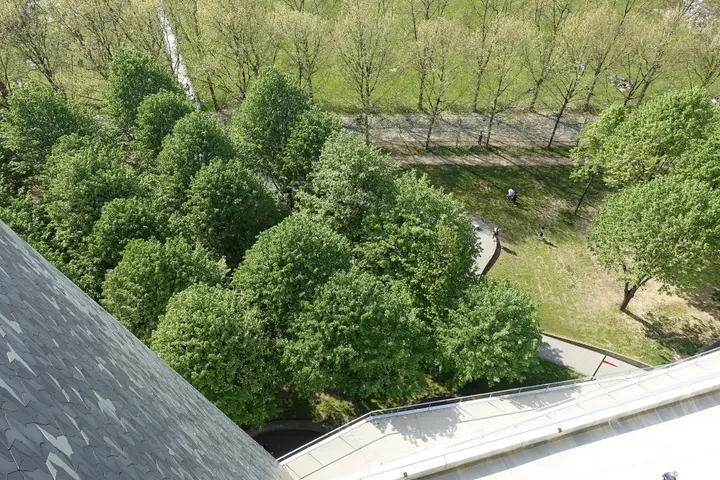
Photo credits
The Philharmonie de Paris and the adjoining Cité de la musique seen from La Villette, with the Philharmonie's aluminium-clad, hill-shaped facade.: Guilhem Vellut from Paris, France · CC BY 2.0
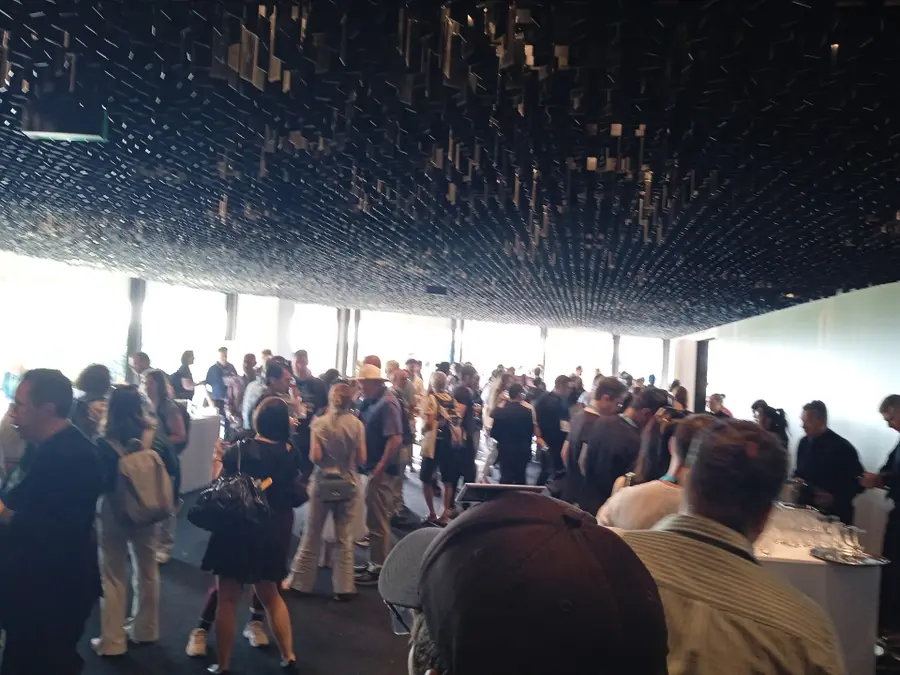
Guests gathered at a reception held in the Philharmonie de Paris in July 2026, in one of its public spaces.: Enrevseluj · CC BY-SA 4.0
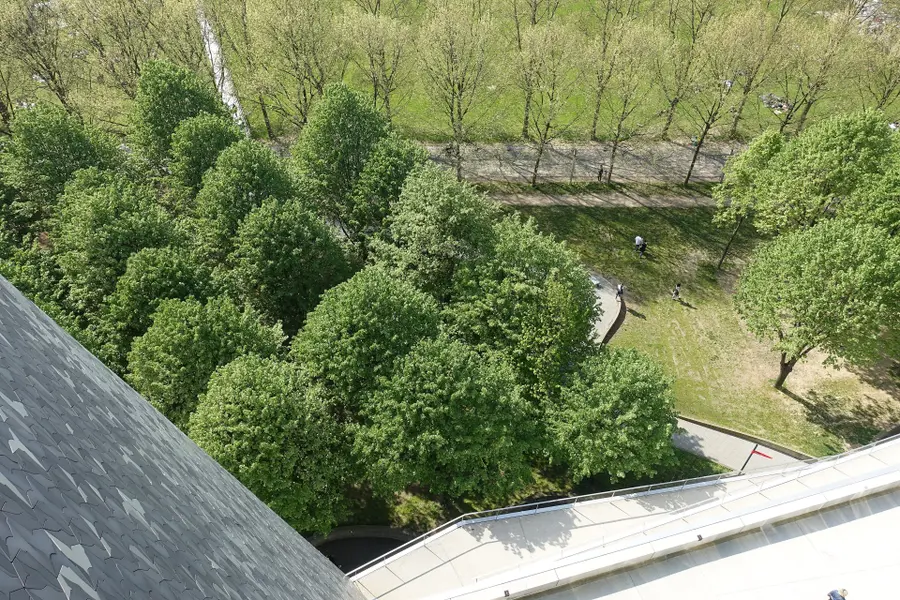
The belvedere terrace at the Philharmonie de Paris, the roof lookout above La Villette in Paris.: Guilhem Vellut from Paris, France · CC BY 2.0
Read reviews on Google Maps We don't show ratings here. See what visitors say on Google Maps.
Frequently asked questions
What time do concerts at La Philharmonie de Paris start and end?
Most evening concerts start at 20:00 local time (19:00 UTC in winter, 18:00 UTC in summer); matinées are around 15:00–16:00 local. A symphony programme normally lasts about two hours with an interval, so plan for an end around 22:00–23:00; your ticket gives the exact time.
How many people fit in the Grande salle Pierre Boulez?
The Grande salle Pierre Boulez seats 2,400 people on terraces that surround the stage. Even the furthest seat is at most 32 metres from the conductor.
Which metro line goes to the Philharmonie de Paris?
Metro line 5 stops at Porte de Pantin, a short walk from the entrance. Tram T3b and buses 75 and 151 also stop there.
How do I get to the Philharmonie from Gare du Nord?
Take metro line 5 direct to Porte de Pantin: it is five stops from Gare du Nord and six from Gare de l’Est. From RER E Pantin, take bus 151 for a few stops.
Where do I park for La Philharmonie de Paris?
Parking Philharmonie (Q-Park) is at 185 boulevard Sérurier with 564 spaces and direct lifts to the Grande salle from the south exit. Two further Q-Park garages, Cité de la musique – La Villette and Conservatoire, are close by.
How much does parking cost at the Philharmonie de Paris?
The venue's visitor page does not publish a fixed parking tariff. You can reserve a space up to two hours ahead on q-park.fr, where the current rate for the Philharmonie and the two Cité de la musique garages is shown.
Can I bring a suitcase or travel bag to a concert?
No. Under the reinforced Vigipirate plan, luggage and travel bags are no longer admitted to the halls or the cloakrooms, and visitors are asked to arrive early for the entrance checks.
Is the Philharmonie de Paris accessible for wheelchair users?
Yes. Disabled visitors can use all the spaces on the site, and the car park has 15 spaces managed by the Philharmonie. A volunteer escort can meet you from the approaches if you book at least 48 hours ahead.
What is the organ in the Grande salle?
It is a symphony organ built by Rieger Orgelbau, with 91 stops and 6,055 pipes, inaugurated on 6 February 2016. It sits behind the orchestra in the Grande salle Pierre Boulez.
Is the Philharmonie de Paris the same as the Cité de la musique?
No. They are two adjoining but separate buildings at 221 avenue Jean-Jaurès. The Philharmonie has the 2,400-seat Grande salle Pierre Boulez; the Cité de la musique has its own halls and the Musée de la musique. Check your ticket.
What is the last metro after a concert at the Philharmonie?
From Sunday to Thursday the last metro 5 leaves Porte de Pantin at 00:50 towards Place d’Italie and 01:07 towards Bobigny. On Fridays and Saturdays it is 01:50 and 02:07.
How can I get a cheaper ticket?
The Philharmonie sets one ticket price per show and also offers a number of reduced-price places. The current categories and reductions are listed on the official ticket page for each concert.
Is there somewhere to eat before the show?
Yes, the Philharmonie building has its own restaurant, and there are more cafés and restaurants in the Parc de la Villette around it. Restaurant hours follow the venue's programme, so check ahead.
How do I contact the Philharmonie de Paris?
Call the ticket office on 01 44 84 44 84, open 11:00–19:00 Monday to Saturday and 11:00–18:00 Sunday, or email contact@philharmoniedeparis.fr. Accessibility questions go to accessibilite@philharmoniedeparis.fr.
Sources: Philharmonie de Paris, French Wikipedia (November 19, 2026) · Official visitor information and French Wikipedia (November 19, 2026) · Official accessibility information (November 19, 2026)